The Suffolk County Water Authority has agreed to extend the deadline for written public comment on its proposed 8.5-mile North Fork Pipeline through Friday, July 11, as residents here digest the proposal for a new water transmission line that the Water Authority has been advocating for for years.
Pictured Above: Water Authority representatives (l-r) Jeff Szabo, Brendan Warner, Joe Pokorney and John Milazzo at the scoping session in Peconic.
The Water Authority held three well-attended Scoping Sessions, asking the public what it would like to see included in a Draft Environmental Impact Statement for both the major pipeline and another 3.8-mile line to Orient, over the past two weeks.
Questions from residents abound about how much water is coming, where it is coming from, what it could mean for development on the North Fork and when a second phase of the project will provide safe drinking water for Orient.
The North Fork Civics and the Greenport Civic Association are holding a follow-up discussion about the pipeline this evening at 6 p.m. at Holy Trinity Episcopal Church in Greenport. Group for the East End President Bob DeLuca, and Save The Sound Long Island Project Manager and Senior Science Advisor Louise Harrison will speak. Here’s More Info.
The civic groups had also held an informational meeting before the scoping sessions.
The two projects are being grouped together in one Draft Environmental Impact Statement (DEIS) to avoid the perception of ‘segmentation,’ the process by which developers attempt to break their projects into smaller parts to avoid environmental review, Suffolk County Water Authority CEO Jeff Szabo told the crowds at two scoping sessions in Riverhead and Peconic last week.
The 8.5-mile western portion, which would tie into the Water Authority’s existing pipeline at Whitebrook Drive in Flanders, is much farther along in the planning process, said Mr. Szabo, who added that the Water Authority would like to complete that project by 2030.
But the Orient portion, which the Water Authority says would help alleviate contamination from PFAS and saltwater intrusion in the shallow wells of Orient, “may never happen,” he said.
“We’re looking at that from an environmental perspective — we included that in the review so we wouldn’t be criticized for segmentation,” he said. “We wanted it to be complete and look at it holistically. That would happen if the people of Orient wanted safe, potable drinking water.”
Both Southold and Riverhead had asked the New York State Department of Environmental Conservation to allow them to be the “lead agent” overseeing the SEQRA review of the project, but the inclusion of the eastern portion in the review had an added benefit for the Water Authority — because the utility’s coverage area involved both towns, the DEC deemed its broader jurisdiction made it the best candidate to do the environmental review of its own project.
At the Riverhead scoping session, Riverhead Town environmental consultant Jeff Seeman asked the Water Authority to come to Riverhead Town Hall to present their plan, and to submit to a “Monroe Balancing Test,” a test done to resolve intergovernmental land use disputes, because “the applicant in this case, which is also the lead agency, believes it may be exempt from land use regulations.”
“The hearing will take place in Riverhead, at an arranged date, with public notice,” he said. “Riverhead’s primary concern, to date, is that we haven’t seen any preliminary engineering plans.”
“I think the benefits to Southold are fairly obvious, due to the saltwater intrusion and reduction in wells,” he said. “We have yet to see any significant benefit to Riverhead.”
From the comments at the Peconic scoping session Thursday evening, June 12, some people in Orient are desperate for safe, potable water, while residents who live closer to the western end of the project were more concerned about its potential to bring more development to the North Fork, and about the statistic that 70 percent of the water is being used for irrigation.
Curt Johnson of Orient Point said the Suffolk County Health Department found 8.6 parts per trillion of PFAS in his well last November, and found 13 ppt when they came back to test in April of this year.
Last year the U.S. Environmental Protection Agency issued a directive that public drinking water suppliers reduce the level of several perfluorinated compounds to under 4 parts per trillion, a goal the Suffolk County Water Authority said last week that it had met six years ahead of schedule.
“A few of my neighbors have gotten sick from this. A few passed away. I feel for the people in Southold who are worried about their bushes and trees, but what is it going to take for the Suffolk County Water Authoirty to get a pipeline out to us before people get sick. I can’t drink the water. i can’t shower with the water. I don’t know what to do.
Peter Schembri of Orient Point was also told by the health department to not drink or shower or cook with his water.
“We’ve got a bigger problem than sprinklers. I want my grandkids to come out and see me, but I can’t do that with a clear conscience,” he said. “This main is tremendous for the future of Southold.”
“The village has a huge problem with PFAS,” he said of downtown Orient. “It’s catastrophic. It’s spread from the village east, and it appears throughout Orient.”
The pipeline as currently envisioned only extends as far east as the center of Orient’s business district, around Village Lane, and does not extend out to Orient Point.
Orient Association President Tony Asch was confused about who would pay for the Orient extension.
The Water Authority says it has budgeted $35 million for the western section of water main as part of its capital budget, and will not pass the costs on to ratepayers, but the Orient section would likely rely heavily on residents paying to hook up to the water supply.
In many areas where the Water Authority extends pipelines, it needs a critical mass of residents to agree to pay to hook up before it can extend water mains, although it has been able to use grant funding in the past to extend pipelines to people whose private wells contain hazardous chemicals.
Nearly 15 years ago, the Water Authority had proposed extending a water main to Orient, using funding from the American Recovery and Reinvestment Act established during the Great Recession. The community had refused the pipeline then, worried about the possibility it could lead to more development. The health dangers of PFAS were little known at that time, and testing for those compounds was not commonplace.
“Why do Orient residents need to pay and no one else does?” asked Glynis Berry of Peconic Green Growth, adding that planning for peak demand “increases the cost of the infrastructure.”
She urged the Water Authority to do more to encourage water conservation.


The western portion of the pipeline, at 24 inches in diameter, is rated to be able to carry 6,000 gallons per minute of water. Many in the audience in Peconic did a back-of-the-napkin analysis of what that would mean in terms of how much more water would be coming east, but Water Authority officials, who had silently taken comment through much of the evening, stopped one speaker to issue a correction after hearing the comment several times.
“We’ve heard this comment before. The pipeline is rated for up to 6,000 gallons per minute, but it will infrequently ever run at that level,” said SCWA Deputy Chief Executive Officer for Operations Joe Pokorney.
He said once the pipeline is built, the Water Authority will likely shut down 12 of its existing 60 wells in Southold, which are suffering from high chlorides due to saltwater intrusion, and will need the water from the pipeline to make up for those lost wells.
“We’re meeting existing demand, but we’re just getting by,” he said. “If we take away a dozen wells, we get to the point where we can’t serve that water, and we’ve got to make it up somewhere. We will be providing the water lost when those wells are lost.”
“It’s going to help meet that peak,” he added. “In the off season, it will run very little. We’re not serving any more people.”
“We should have done a better job of explaining all of this to you,” said Mr. Szabo.
Several commenters, including Southold Town Supervisor Al Krupski, asked about the source of the water, which had been reported to be at the Flanders hook-up site.
Water Authority Director of Construction and Maintenance Brendan Warner told reporters at the Riverhead scoping session that, while the interconnection point is in Flanders, the source of that water is from deep wells near Speonk-Riverhead Road, atop the groundwater divide in an area of little development, and near Moriches-Riverhead Road (County Road 51), where the Water Authority has a great deal of storage capacity.
That site was not mentioned at the Peconic Scoping Session, where Mr. Warner described the water as coming from the “South Shore Low Zone,” a pressure zone that has more than 100 wells with excess capacity.
Mr. Warner was also quick to point out that the Riverhead portion of the pipeline, which would go up Route 105 to Northville Turnpike to Sound Avenue, where it will continue east to the Southold Town Line, will be solely a transmission line, with no hookups to properties along the way, many of which are in the separate Riverhead Water District.
“There won’t be any service connections along the pipeline. It will be a transmission line from one pressure zone to another,” he said.
He added that the Water Authority “obviously knows that Sound Avenue is a corridor in the fall for all agriculture-related festivals, and we would plan our construction schedule around that.”
The transmission line would be installed primarily by digging down into the roadbed, with the road open in the section where the Water Authority will be working each day. It includes three areas of directional drilling, horizontally, below ground — 30 feet below the Peconic River, under Hubbard Avenue along Route 105, and under the Main Road.
Many environmentalists asked the Water Authority to have its consultants, Nelson + Pope, examine the “growth-inducing impacts” of the water main.
Southold Conservation Advisory Council Chair Carol Brown estimated the project would provide 2.6 times the amount of water that is now being used by the Water Authority’s current North Fork customers, which number at about 9,500 customers.
“Why do we need to have 30,000 people?” she asked. “There are unintended consequences. If the town enacted legislation to require water conservation efforts, would this project still be necessary?”
The Southold Town Board is holding a public hearing on irrigation restrictions at its June 24 meeting at 4:30 p.m.
“I think the growth inducement risk is probably larger in the Riverhead area,” said Group for the East End President Bob DeLuca, adding that proposed developments along Sound Avenue in Riverhead “are of interest to the Town of Southold. You need to stipulate that a transmission line is a transmission line is a transmission line, not a distribution line.”
“To the extent that public water is ever headed for Orient, let it be at the will of the folks who live there,” he added.
Joel Klein of Mattituck asked the Water Authority to take into account a project currently “in semi-limbo before the Southold Planning Board” that would involve thousands of trucks filled with sand traveling down Sound Avenue to clear a hillside for Strongs Yacht Center’s proposed yacht storage buildings.
“Would this be a problem should they occur simultaneously?” he asked.
North Fork Environmental Council Southold Land Use Coordinator Anne Murray asked if the source of the new water would also be vulnerable to overpumping, and asked the Water Authority to explain how the project is consistent with Southold Town’s Comprehensive Plan.
She also asked them to examine the impacts of “increased septic waste that will result from increased development in the Town of Southold.
“What we really need to do is reduce consumption,” said Jeanette Dumas of Southold. “One of the best things we can do is get people to not have acres and acres of lawns. I don’t believe providing more water is a sustainable, long-term solution. The solution is, I would say, draconian conservation measures…. This is a classic example of the tragedy of the commons. If we supply more water, I think it’s going to be used.”
North Fork Environmental Council President Mark Haubner also asked the Water Authority to examine the growth inducing impacts of the pipeline, and to conduct a traffic study of the potential for that growth to increase automobile traffic.
“It is becoming a major corridor and I think it needs to be studied,” agreed Kathy McGraw at the Riverhead scoping session.
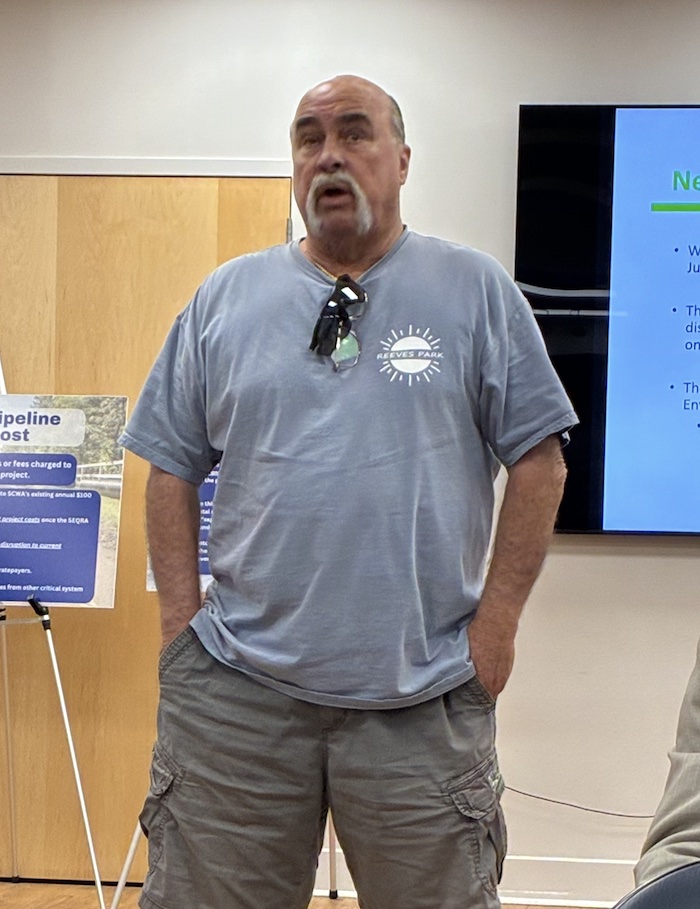
“This thing will be delivering 8.5 million gallons at its max, and the total usage in Southold is a fraction of that,” said Mike Foley of Reeves Park at the Riverhead scoping session. “It seems clear you are preparing for an excessive expansion on the North Shore of Long Island. That’s something the residents don’t want and don’t need.”
“You guys are getting a tremendous benefit out of this expansion,” he said, adding that the historic Sound Avenue corridor is something that “people in this room have been fighting to protect for the last 50 years. Clearly our fight is not over.”
The environmental review documents prepared to date, Mr. Szabo’s PowerPoint from the scoping sessions and a link to comment on the plan are available on the Water Authority’s website at www.scwa.com/nfp.
Written comments will be accepted through the form on the website or by contacting Joseph M. Pokorny, PE, Deputy CEO for Operations, Suffolk County Water Authority, P.O. Box 38, 4060 Sunrise Highway, Oakdale, NY 11769, or by emailing joseph.pokorny@scwa.com.
The deadline is now Friday, July 11 at 5 p.m.
Mr. Szabo said the Water Authority’s consultants will next prepare a final scoping document, which will be made available on its website, after which they plan to complete the Draft Environmental Impact Statement this fall or early winter, followed by another round of public comment sessions.
The Orient Association videotaped the June 12 scoping session, which you can watch on YouTube.
Read Our Past Coverage:
Keep Independent News on the East End
The Beacon is able to provide all of our content online free of charge thanks to support from our readers. Be a vital part of keeping our community informed!
Advertisement