With the countdown to the 2024 election measured now in just days, voters are bound to be bombarded with a flurry of information, misinformation and downright propaganda in the next several weeks.
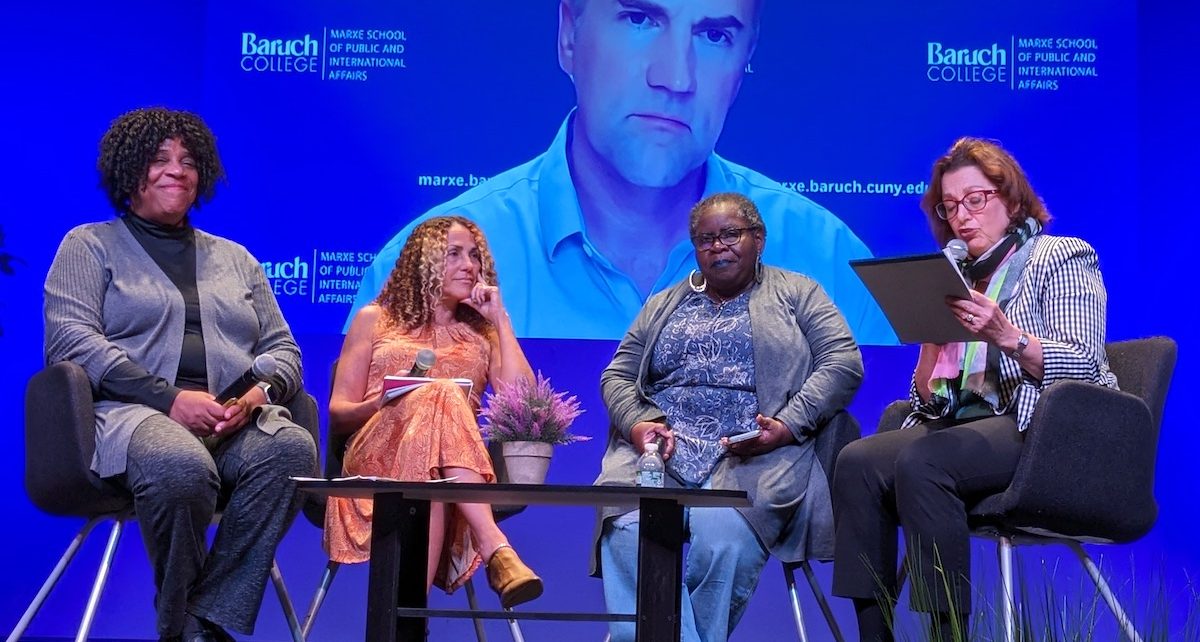
Pictured Above: (l-r) Sonia Jarvis, Minerva Perez, Bonnie Cannon and Andrea Gabor (with Don Waisanen on the screen) at the LWV forum.
It’s with that in mind that the League of Women Voters of the Hamptons, Shelter Island and the North Fork invited a panel of experts to a discussion on “How to Confront Misinformation and Build Trust in the 2024 Election” at LTV Studios in Wainscott on Sept. 24.
It’s not news that social media companies’ algorithms exploit our interests to show us more of the things we engage with on their platforms, but the degree to which artificial intelligence has amplified these algorithms can’t be underestimated, said professors Don Waisanen and Sonia Jarvis from Baruch College/CUNY, and panel moderator Andrea Gabor. And the role of foreign governments in creating disinformation is also increasing, with Iran and Russia now working through social media to influence the U.S. presidential race.
Add into this mix the unsustainabilty of local news media models, in which many reputable news sites have put their content behind a paywall while free content that doesn’t provide the kind of journalistic rigor expected by former generations of news consumers is rampant.
“For every quality news site, you have dozens of toxic sludge,” said Ms. Gabor.
Panelists said they believe the roots of these problems date back to the Citizens United Supreme Court case, which allowed corporations to donate previously unheard of amounts to campaigns, and the lack of social media regulation in the 1996 Telecommunications Act, but many of their proposed short-term solutions focus more on our individual behavior.
So what’s to be done, in the few short weeks before election, to prevent the spread of propaganda?
They do have some helpful tips.
“Any time someone tells you to be outraged or fearful, that is the moment to put on your critical thinking hat,” said Mr. Waisanen. “These are emotions that have been manipulated in our media. It’s right out of the classical propaganda playbook. Suspicion and fear really feeds irrationality.”
Mr. Waisanen suggested that propaganda techniques should be taught now “in every curriculum, in every school,” so that we are raising a new generation aware of the dangers of propaganda.
He suggested people also remember three modes of communication — debate, deliberation and dialogue before getting into political conversations.
“I’ve met a lot of folks who have never done anything but debate, but in a dialogue, you learn about what someone else believes and how they came to believe that,” he said, adding that a new field of campaigning, “deep canvassing,” aims to spend time with voters to understand their concerns.
“Listening to understand is incredibly important,” he said. “That’s another way through the thicket we’re in.”
Ms. Jarvis recommended the resources of the News Literacy Project, which is working to engage students to “make sure they’re able to participate in our civic society, as informed critical thinkers.”
She added that the website allsides.com provides coverage “from left, right and center news sources, which gives voters the opportunity to compare and contrast.”
Ms. Gabor recommended looking at the “About” page of a website before reading an article there, to determine that website’s perspective.
“All news media has a point of view,” she said.
The group also recommended several fact-checking websites, including Snopes, factcheck.org, Politicifact (available in Spanish and English), VerifyThis.com, the Rand Corporations’s Lead Stories Fact Checker and Poynter’s Mediawise Teen Fact Checking Network.
Panelist Minerva Perez, Executive Director of OLA of Eastern Long Island, said social media usage is very high among Latin American residents of the East End, and OLA has used those platforms to help get the word out about specific threats to the Latino community, including Immigration & Customs Enforcement raids here. But misinformation can also spread quickly through these channels.
“A lot of weight is put on the Latino vote, but no love and care is put within the community,” she added. “A lot of information, on a local level, isn’t allowed to exist in Spanish because the language itself has become so politicized.”
“Slow down to where we are seeing the humans around us,” she added. “If you don’t speak the language, find someone who does. It’s very important to not cut people out.”
Bonnie Cannon, Executive Director of the Bridgehampton Child Care & Recreation Center, agreed that we need to slow down our communication, and pinned the source of much of the hyper speed at which information is spread as the cell pones we all carry around.
“How do we get back to paying attention? We’re getting a fire load of information coming at us every single day. Are you really absorbing the information?” she said. “You have to stop and you have to slow down and you have to read and research.”
She added that schools are limited in what they can teach during the school day, but that’s where there’s an opportunity for community organizations like the Bridgehampton Child Care Center.
“We are unregulated and have more opportunities to address those types of situations in a meaningful way,” she said.
“Libraries are being taken over in some states, and certain books are not able to be read anymore,” said Ms. Jarvis. “That’s a danger. Each community should be asking if their library is a place for students to study and feel safe while doing it.”
“Slow down, get humble about what you know, and start talking to others,” said Mr. Waisanen.
— BHY
Keep Independent News on the East End
The Beacon is able to provide all of our content online free of charge thanks to support from our readers. Be a vital part of keeping our community informed!