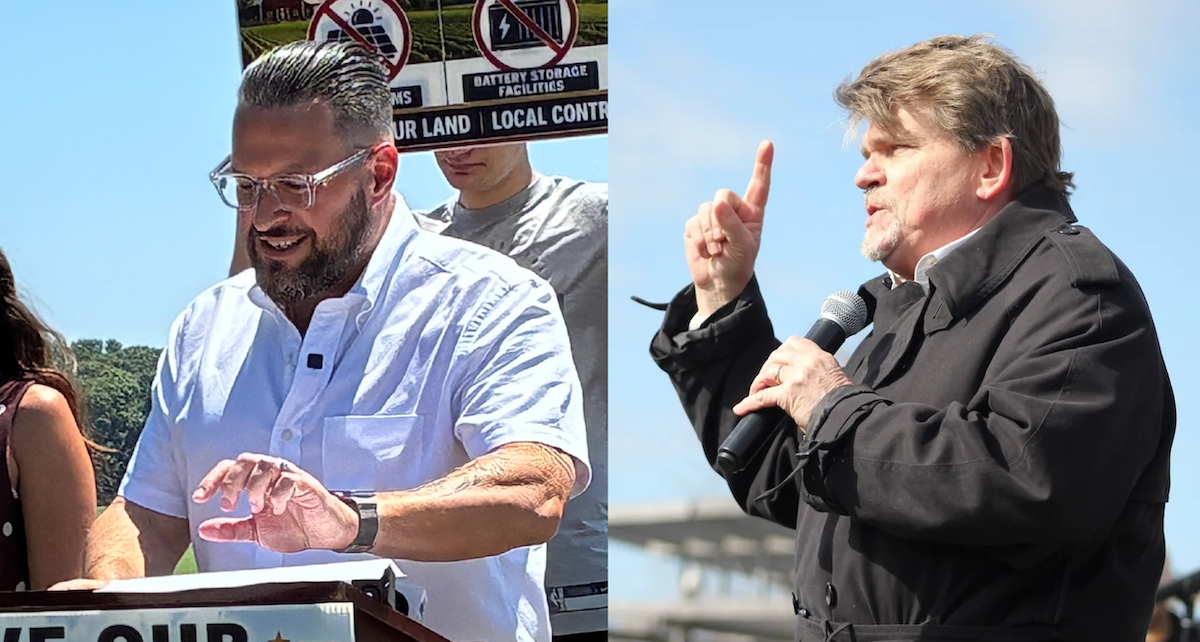
Two years after retired social studies teacher Tommy John Schiavoni was first elected to the New York State Assembly, he is again facing a challenge from attorney Stephen Kiely, whom he beat with 55 percent of the vote in 2024.
Pictured Above: Stephen Kiely (l) and Tommy John Schiavoni (r)
Mr. Schiavoni, a former Southampton Town Councilman, has been a passionate supporter of equitable housing opportunities and climate resiliency, and a critic of the policies of the current federal administration — particularly the excesses of immigration enforcement — during his tenure in Albany.
Mr. Kiely has made a name for himself championing immigration enforcement actions and criticizing the state, saying it has overreached on renewable energy and overdevelopment.
We spoke with both candidates this week about some of the most heated issues in this campaign.
On The State of Immigration
Perhaps the most stark difference between these candidates is their stance on current federal immigration enforcement practices.
“I’m frankly horrified that the national government has created what I consider to be a paramilitary force to be used inside the United States that they are now funding to the tune of twice what they’re funding for the United States Marine Corps,” said Mr. Schiavoni, who often talks about his experience as a second generation American whose family came here from Italy. “They come into our American communities with full tactical garb and automatic weapons and with their faces covered. That’s frankly shocking and shameful to me.”
Mr. Schiavoni said he stands by protection of due process for people detained by federal immigration authorities, and by the state’s ban on 287(g) arrangements that codify local law enforcement agencies working together with Immigration & Customs Enforcement (ICE).
“The term that is used, in due process, in the United States Constitution is “all persons,” and it means exactly that,” he said. On the ban on 287(g) agreements, he said “I voted for it. I would do it again.”
“I would suggest that the federal government pass an immigration law,” he said. “We haven’t since the 1980s. They would have their hearings and compromises and their fights — you know, the legislative process — but that’s not how this is happening. This is the decree of one person.”
Mr. Kiely, a former Shelter Island Town Attorney who now works as the Assistant to the Director of the Suffolk County Real Property Tax Agency in Riverhead, also does weekend and holiday arraignments in Riverhead Town Justice Court.
He says his stance on federal immigration issues comes from first-hand experience.
He said he was driven to run for State Assembly again, as a parent of a daughter, after arraigning a man who was arrested for public lewdness after allegedly “pleasuring himself in front of an 11-year-old girl walking home from middle school.”
He said the judge was not allowed to set cash bail and the defendant “had a detainer from ICE, but the police department was not allowed to call, and the guy just walked out of court, when he was a clear and present danger to the community.”
“Other crazy criminal charges are not bailable in New York — stalking, arson, support of terrorists, killing a police dog,” he said. “You can possess child pornography and a judge is not allowed to set bail on you. All this was brought up to the Democrat majority, and it was not fixed. Let the judge, like in any other state in the union, take dangerousness of the defendant into account when setting bail.”
Mr. Kiely said that Nassau County, where County Executive and Republican gubernatorial candidate Bruce Blakeman proudly entered a 287(g) agreement with ICE prior to the state ban, “is the safest county in America.”
“I’m not heartless,” he said. “I agree that migrants coming here, working and being part of our social fabric — let them pay a fine, learn English, have a path toward citizenship. I’m fine with that. I’m not fine with us allowing ourselves to be endangered by violent criminal migrants.”
On the Housing Crisis
Mr. Kiely says that the presence of migrants in New York “does have other consequences, like on housing prices. The starter homes and affordable housing is all bought up by slumlords and packed with migrants, off the market.”
“That, combined with airBNB, is why the East End has an affordability crisis,” he said.
Mr. Kiely said he helped draft Shelter Island’s Community Housing Plan while he was the town attorney there, but he does “not think we should build housing. We should provide opportunities for cheap rentals. I lived in a garden apartment complex and I also rented houses and got on my feet. A lot of young folks need an opportunity to rent where it’s affordable while they save up for a down payment. But nobody’s entitled to live where they grew up.”
Mr. Kiely said he would support repurposing existing commercial buildings as rental apartments.
He’s not happy, he said, about the state’s rollbacks to the State Environmental Quality Review Act (SEQRA) included in this year’s budget to enable the construction of more housing without environmental review.
“Our friend, Governor Kathy Hochul, has a ‘Let Them Build” agenda. If she wins, along with her lemmings in Albany, they are going to destroy community character,” he said, adding that the state says it needs 800,000 units of housing and “if you do the numbers, that’s very similar to the number of migrants who have come in since the border was opened. Not to be conspiratorial.”
Mr. Schiavoni is no fan of the changes to SEQRA included by the governor in this year’s budget, and he takes particular issue with the fact that there is no stipulation that the houses that could be built without SEQRA review be affordable.
“It reads in the law that farm fields that are out of production for three years are considered previously disturbed parcels, and are exempt from SEQRA,” he said. “Now we have billionaires that own these farms, and if they keep them fallow for three years, which is not hard to do, they don’t have to follow SEQRA. It’s just a disaster waiting to happen, in my opinion. The Governor wanted it. The Senate wanted it, and a lot of my colleagues in the Assembly, their attitude was ‘our municipalities get sued on SEQRA all the time. It’s expensive and we’re not getting housing done.’ But the governor’s people were saying, look, if the local municipalities don’t want it, do it with your zoning. When people come in for variances, you’ve gotta sit back and fold your arms and say no. It’s still in local government’s power.”
Mr. Schiavoni said he’s proud of his work to bring $2.65 million in state money to the Village of Greenport for sewers and parks, in support of the village’s goal of increasing affordable housing.
State Assembly Speaker Carl Heastie is also working to secure another $8 million for Greenport in 2027.
Mr. Schiavoni, who comes from a family of plumbers, said the key to building more housing is going to be upgrading sewage infrastructure.
He touted the state’s work with Southampton Town, where he was formerly a councilman, to fund a sewage treatment plant in Riverside, an area that is expected to be redeveloped with a focus on community housing.
“It’s terribly important. Sewers are expensive, but this is 100-year infrastructure. It is going to outlive me, and dollar for dollar, pound for pound, as far as removing nitrogen goes, it’s more effective than an IA system,” he said.
“These two communities, Riverside and Greenport, are considered disadvantaged communities according to the environmental justice realm of the state’s Climate Leadership and Community Protection Act,” said Mr. Schiavoni. “In this district, we have a lot of very well-heeled areas, and areas that do need a head start. I think it’s money well spent.”
Mr. Schiavoni has also been keeping tabs of the money generated by the new Community Housing Funds in four of the five East End towns, established building on work by his predecessor in the State Assembly, Fred Thiele. He reported last month that the funds have generated more than $100 million since they were established in 2023.
“I’m putting these announcements out because I want the world to know how much money is being collected, and fan the flame for the towns to do something with the money,” he said.
“What needs to happen now is under the jurisdiction of the towns,” he said. “Where I can help, I will.”
On Rollbacks to Climate Protection Goals
Also this spring in Albany, the state rolled back its goals for conversion to renewable energy set in the 2019 Climate Leadership and Community Protection Act (CLCPA).
“When that bill was argued, in 2019, Assemblyman Steve Englebright, the prime sponsor, was arguing that the goals were aspirational,” said Mr. Schiavoni. “It’s great to have goals, unless you can’t meet them, and then you have to adjust your goals.”
“In Washington, we’ve got a hostile administration — he’s literally unilaterally cancelling leases for wind farms that are more than three quarters of the way built. It makes no sense. I’m floored with the tactics of these folks. We need wind power.”
“The governor is turning to nuclear power, but we still haven’t solved where we put spent nuclear fuel,” he added.
Mr. Schiavoni said he understands the pushback against the state’s wholehearted support for Battery Energy Storage Systems (BESS), especially after three recent BESS fires in the New York, including one in East Hampton that is believed to have contaminated nearby public drinking water wells.
Mr. Schiavoni, a former Sag Harbor firefighter, said he’s been asking for stronger fire safety standards since his time as a town councilman, when residents of Hampton Bays were concerned about a large BESS proposed near the Shinnecock Canal.
“NYSERDA wanted to have 6,000 megawatts of battery energy storage. I don’t see it happening,” he said. “I do believe they are safe, but they scare the hell out of people. They need thousands of watts of battery storage to make green energy a reality. There are concerns that have to be addressed. As we move forward with this technology, the design of the storage is going to be improved. And they can do preventative maintenance — maybe the batteries get changed out every two years, whether they need it or not. Battery energy storage fires are quire rare, given the amount of them that exist. But people hear that they’re dangerous and they don’t want them in their neighborhoods.”
Mr. Kiely held a press conference this summer at a site in Cutchogue where a BESS had previously been proposed, announcing his anti-BESS platform.
“I would sponsor a bill to ban BESS in rural areas,” he said. “When you have a land use that is poisonous to the environment, there should be state legislation prohibiting it.”
Mr. Kiely said he visited residents who live near the East Hampton BESS and “they’re sick over this, that this would be allowed to be put over such a thin aquifer.”
He said he thinks the Climate Leadership and Community Protection Act “should be put in a dumpster. The climate goals — my problem is that it’s DEI cloaked in climate, and big green energy is behind it.”
“The whole thing needs to be scrapped and redone,” he said. “No one says climate change is fake, but I just want common sense solutions and I don’t want things forced on me.”
He added that he recently bought a hybrid Jeep because it was the only Jeep that could be sold in New York by the dealer he went to, but it had six recalls and “I’m always nervous it’s going to die on the side of the road.”
On The Future
Mr. Kiely said that, even though he knows his message may not be heard by the Democratic majority in Albany, “I would scream and have the bully pulpit and put pressure on the electeds to change this….. I’m not shy. I’m loud.”
“People on the East End are naive or ignorant to the real crime that’s out there,” he said. “I see the seedy underbelly. It’s frustrating, and it doesn’t get through to the power brokers and the zealots. We have an extreme leftist Southold Democratic leader, and she’s just gonna use the East End as a laboratory for those woke socialist policies she wants to push. We’ve gotta get back to the days of moderate common sense voices.”
Mr. Schiavoni said he has more hope for the future of democracy after his first two years in Albany.
He’s proud of having been a fiery speaker at pro-democracy rallies over the past two years, where he’s often talked about American history, government, and the importance of this moment, leaning in to his experience as a history teacher.
“This is, in my opinion, a dark chapter in American history, but this chapter is not over,” he said. “We have had challenges in the past, and and we have come through it. But I have a lot of faith in our republic, in our founding documents, in this state, the national government, and the American people. I believe in the separation of powers. We were not designed to have one person rule. That’s why Article One of the Constitution gives so many powers to Congress.”
“If people don’t like it, and they don’t vote for me, that’s fine,” he said.
Keep Independent News on the East End
The Beacon is able to provide all of our content online free of charge thanks to support from our readers. Be a vital part of keeping our community informed!
Advertisement