

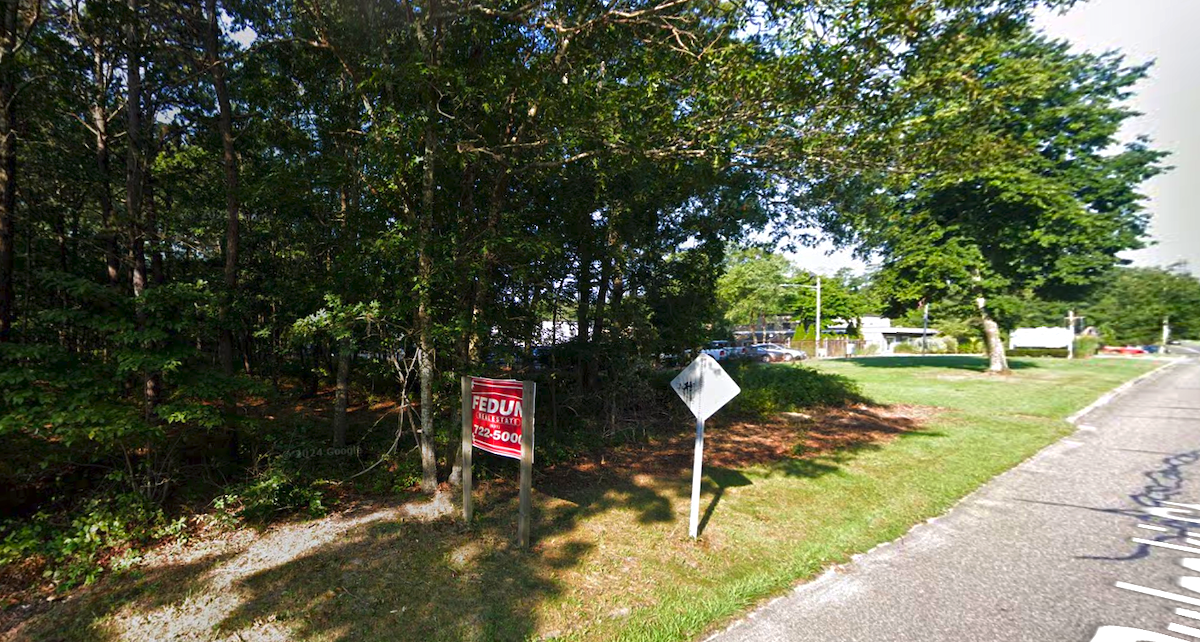
The Riverhead Town Board is apprehensive of a special permit request for a 5MW/20MWh Battery Energy Storage System on the corner of J.T. Boulevard and Pulaski Street, in an area near many modest homes.
Pictured Above: A 5 MW Battery Energy Storage System has been proposed on Pulaski Street in Riverhead.
The project, proposed by Boston-based Pulaski Street Storage LLC, would be at 1281 Pulaski Street, adjacent to Riverhead Town Hall West and across Pulaski Street from Stotzky Park and the rear of the Lowes home improvement store.
According to the site plan, which the board discussed at its March 12 work session, the batteries used in the project would be three containerized Tesla Megapack units, which utilize Lithium Iron Phosphate battery chemistry(LFP), which have been shown to be safer than earlier, Lithium Ion-based battery chemistry.
Tesla Megapack batteries were also the choice of the developers of a proposed BESS system on Scott Avenue at EPCAL, one of two other recently proposed BESS systems in Riverhead. The other, at the Hampton Jitney terminal on Edwards Avenue, relies on EVO Power FLEX Series batteries.
There were no public comments opposing either of the other projects at a Feb. 18 public hearing before the Town Board, which was held open for written comments until March 2. Those projects have not yet received special permits from the Town Board.
After several fires involving lithium ion BESS fires in 2023, New York State revamped its BESS code in 2025, requiring emergency response plans and site-specific training for local fire departments, among numerous other requirements.
After several controversial BESS applications, Riverhead had adopted town code addressing siting of BESS facilities in 2023, limiting where larger Tier 2 battery energy storage systems (greater than 600 kWh) can be placed and requiring a special permit from the town board as well as site plan approval from the town’s Planning Board.

While the property at 1281 Pulaski Street is zoned light industrial — an area where Tier 2 BESS facilities are permitted, both Town Board members and the Suffolk County Planning Commission are wary of such a project so close to neighboring homes.
“I’m concerned about the location. There is a neighborhood behind this, and a house on the corner of J.T. Boulevard,” said Councilwoman Joann Waski as town planners and representatives of the applicant presented the plan at the Town Board’s March 12 work session. “I need to be a voice for the residents. I do not think this project belongs on this property, so close to the residents of this town.”
Councilwoman Denise Merrifield, who had applauded the two other BESS proposals that did not border residential neighborhoods, asked what kind of fumes could be expected if the batteries caught on fire.
Nick Petrakis, a Fire Protection Engineer with Energy Safety Response Group, a BESS consulting firm working with the applicant, said that “nothing exotic comes out of smoke from this… there’s been a tremendous amount of air sampling, and they haven’t found anything outside of the norm…. They have tested the components of the off-gassing, and there’s carbon monoxide, like with any structure fire.”
But, he said, “the off-gassing of a structure fire is not great.”
He added that Tesla has put this particular battery pack model “through a tremendous amount of destructive fire testing,” and he would provide that data to the town.
“A structure fire is in someone’s home, where they live. We’d be choosing to put this here,” said Town Supervisor Jerry Halpin. “That specific community is typically more affordable. I understand where your logic is going, but I don’t think it’s landing. We need to come up with something better.”
Councilman Ken Rothwell asked if those air monitoring systems would be in place prior to a fire, but Mr. Petrakis said the initial testing would be done by the fire department, which carries gas meters on its apparatus, when it arrived on scene.
Mr. Rothwell, a member of the Wading River Fire Department, said gasses would be spreading upward and moving offsite, and the fire department meters might not get an accurate reading.
“We had a very serious fire here on Youngs Avenue, and the public had genuine concerns about what was moving through the air,” he said. “No administering body had the ability to immediately respond to the site to test the air quality. Being so close to residential homes — what kind of air quality can we be absolutely certain of…? We have seniors and people with pre-existing conditions, who have their windows open on a July afternoon and this thing goes up? That’s a concern of mine.”
Town Senior Planner Matt Charters said New York’s 2025 Battery Energy Storage System code is “probably the most robust in the country…. The controls the state put in place make them as safe as they can be.”
“Yes, if something happens here, it could catch on fire and there would be smoke. It would not be dissimilar to a structure fire, but unlike a structure fire, these have controls to prevent them from catching on fire for a long time and spreading and going into thermal runaway,” said Mr. Charters, referring to a process by which battery cells in close proximity to one another overheat neighboring cells, causing them to also catch fire. The latest BESS technology containerizes groups of cells to limit the amount of thermal runaway that can occur, and continuously monitors the containers to determine the temperature, voltage and gas levels.
“They have come a long way,” he said.
The Suffolk County Planning Commission has recommended that, since the property is located within a Potential Environmental Justice Area, “the local municipality should coordinate, prepare and implement an enhanced Public Participation Plan,” according to the town Planning Department’s Staff Report. “Traditional forms of outreach, as well as modern forms of social networking, should be utilized. Other forms of outreach, especially to local civic associations and neighborhood religious organizations, should not be overlooked. All documentation and explanations regarding the project and process should be clarified in plain language and communicated orally or by infographics if necessary.”
The Planning Commission also recommended all optional public hearings be conducted, and translation services be made available. It also recommended notice of a public hearing be posted at least 60 days before the hearing, in multiple languages, including “at least one local non-English speaking newspaper,” and that the town not take action on the project until at least 45 days after the close of the public hearing.
Public hearings have not yet been scheduled at this time.
The town Fire Marshal’s office noted that the town does not yet have a Hazmat Response Vehicle equipped with decontamination, containment and cleanup equipment, and while the town is working to develop a New York State Type 3 Hazardous Materials Response Team, in the meantime Riverhead’s volunteer fire department would respond to any incident, which “may tie up equipment needed for additional incidents for extended periods,” according to the staff report.
Town Board members also requested an access road to the site be moved from J.T. Boulevard to Pulaski Street so that it would be farther from freshwater wetlands. While the town’s Conservation Advisory Council had ok’d the project with the access on J.T. Boulevard, the Town Board asked that the CAC reconsider their approval.
The project is also slated to be discussed by the Riverhead Town Planning Board at its next meeting on Thursday, March 19 at 3 p.m.
Keep Independent News on the East End
The Beacon is able to provide all of our content online free of charge thanks to support from our readers. Be a vital part of keeping our community informed!
Advertisement


