

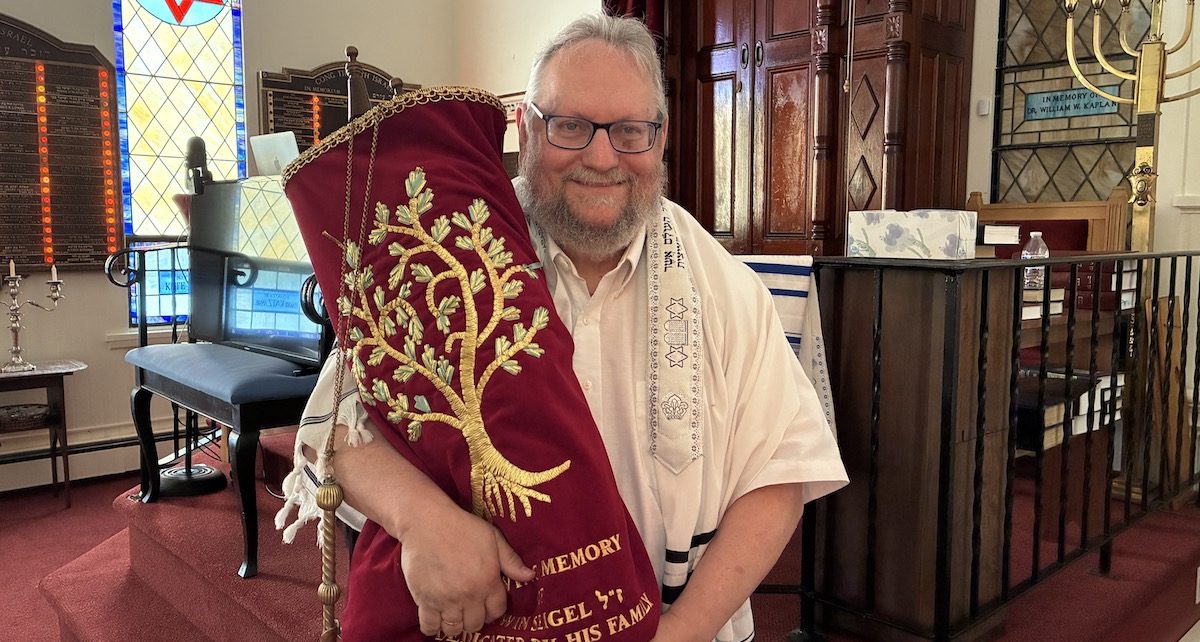
The new rabbi at Congregation Tifereth Israel in Greenport, Robert Wolkoff, didn’t start out life wanting to be a rabbi. He enrolled in Wesleyan University in Connecticut in the midst of the tumultuous year of 1969 intending to become a nuclear physicist.
He was fascinated, at the time, with the weirdness of quantum mechanics.
Pictured Above: Rabbi Robert Wolkoff preparing for the High Holy Day services earlier this month.
He was born into a relatively secular family ( ‘my father was a Trotskyite — religion is the the opiate of the masses and so forth,’ he told us in mid-September), but he attended a Conservative synagogue in Scranton, Penn. with his mother.
His first week in college, sure of his intended profession, he went to a Jewish meet and greet on campus. The first people he ran into there were a nuclear physicist talking with a professor of Jewish Studies.
“The nuclear physicist was the smartest person I’d ever heard in my life. And then I heard the Jewish studies professor, who was even more impressive,” he said. “That first semester, I changed my major. Wesleyan had a reputation at the time, and it’s probably still true, as having the the most transformative impact on their students.”
But the roots of Jewish mysticism aren’t really that far afield from the wonders of physics that we’re just beginning to uncover.
“Quantum mechanics is exceedingly weird stuff,” said Rabbi Wolkoff in an interview with The Beacon in his office at CTI in mid-September. “There has to be a spiritual explanation. At a certain point, rationality runs out, and then you get into a level that’s inexplicable without something that verges on the mythological. When you live in the world of subatomic physics, that’s what you’re talking about.”
“The Biblical view is creation out of nothing,” he added. “We have discovered that there’s matter and anti-matter. When you put them together, they neutralize each other, and we now know that, out of nothing, the matter and anti-matter can separate. This is a just-now recognized physical reality. Creation out of nothing is happening all the time. Who knew?”
As a kid growing up in Scranton in the 1950s, Jewish mysticism was not a subject he explored.
“This is just after the Holocaust, and after the founding of the State of Israel. It’s when Jews really were overcoming the latent anti-Semitism in the United States,” he said. “For the vast majority of us, Judaism was basically an ethnic association with some religious underpinnings. You were just as likely to be involved in the Jewish community center youth group as you were in the synagogue youth group. It was just a bunch of Jewish kids getting together. I was never embarrassed about being Jewish, but I didn’t really see the profundity of the tradition. It seemed like a bunch of one-liners with holidays.”
While his father wasn’t religious, he would always ask young Robert when he came home from temple, “What did the Rabbi talk about today?”
“My rabbi, Simon Shoop, was very active in working with the Jesuits in Scranton and doing interfaith activities — it’s when interfaith stuff was just starting,” he said. “I eventually came to appreciate, even before I went to rabbinical school, the dignity of my hometown rabbi and the contribution that he was making to society. He was actually helping to shape a world where Jews would be accepted.”
“My inclination, when my father would ask, was to think ‘what do you care what the rabbi talked about?'” he said, “But then I saw that what the rabbi talked about was an anchor point for the community. All over our community, there were people that were coming home and having their Saturday lunch and talking about what the rabbi had to say. This was at a time long before cable television or the avalanche of information sources and information silos. People talked about what he had to say. It didn’t make him necessarily right or wrong, but he was a real smart guy who had a real moral grounding and he had an opinion that mattered. Whether you disagreed or agreed, you cared and you saw what he said as a sort of setting the boundaries of what we need to talk about. There were times, for example, when the rabbi expressed support for the Civil Rights Movement. He was talking about Rabbi Abraham Joshua Heschel marching in Selma with Martin Luther King, Jr. and praying with his feet.
“The end of my freshman year was the summer of ’70. It was Kent State. It was the invasion of Cambodia. It was the Grateful Dead concert on my campus the same weekend as the student strike,” said Rabbi Wolkoff. “At that moment in time, I really had to make a choice between religion and politics. I reasoned to myself, you know, there are a lot of people that can go into politics. There aren’t that many people that are going into religion. When you think about it, there were, during the 60s, thousands and thousands of politicians. How many of them have the impact of Martin Luther King? Religious people potentially have extraordinary power, totally because of persuasion. We have no coercive power whatsoever. I can’t make anybody do anything. It is only the power of the ideas that I convey, and those ideas are coming out of a tradition.”
Rabbi Wolkoff would then go on to study at the Jewish Theological Seminary in New York City, before leading congregations from Manitowoc,Wisconsin to Savannah, Georgia to Gothenburg, Sweden. He landed at Congregation B’nai Tikvah in North Brunswick, New Jersey, where he served for 18 years before coming to Greenport this fall.
During that time, he raised three children, Alex, Joseph, and Dahlia, with his wife, Ruth-Ann, who passed away four years ago just four minutes before the start of Yom Kippur.
Ruth-Ann, a “highly trained textile and quality assurance engineer and possessed an active and socially conscious mind,” according to her obituary, “was brilliant and beautiful,” said Rabbi Wolkoff. Indeed, the timing of her death signified a person of great character in the Jewish tradition.
There’s an intensity to the new rabbi coming to Greenport, and to a new congregation, just before the High Holy Days, during which religious Jews engage in a period of intense self-reflection.
The Greenport congregation put out a call for a new rabbi earlier this year, after a contentious breakup with their former rabbi, Gadi Capela, who has started a new congregation in Cutchogue.
“I know that people were tremulously pained by everything that went on,” Rabbi Wolkoff said of his new congregation. “I think that people really want to move on. I don’t know any of the specifics of what happened and why, but I would never tolerate any kind of ugly, slanderous talk, because it’s inappropriate. There is an intensity to rabbinical relationships, so it does not surprise me that there is so much emotional energy.”
“This is a time when we were supposed to be thinking about what we did wrong — what we did right also — but how can we improve?” he said of the High Holy Days, as he prepared the Torah for Rosh Hashanah by rolling it back to the beginning. “‘What were the psychological dynamics that made me do things that I know were wrong? ‘Everybody can make a mistake. But a lot of the stuff that we do is not a mistake. It a choice. This is the time when we are supposed to be able to look at ourselves and say ‘if I’m not careful, I’m gonna be making that bad choice again. And what do I need to do to break that habit?'”
“I once had the opportunity to study with a real serious hot shot Freudian psychiatrist,” he said. “And I said to him, Why does it take you six years to figure out what the problem is? And he said, ‘it doesn’t take us six years to figure out what the problem is. We can figure out the problem within six minutes. It takes six years for the person to be able to grapple with what the problem is.'”
“In our heart of hearts, we all know what the problem is, but we don’t know how to solve the problem,” he said.
“Our repeated prays hammer home this idea,” he said. “These prayers are not just oh, G-d ‘forgive me.’ It’s oh, G-d, help me be worthy of being forgiven. People have this rather ugly and stupid idea about Roman Catholic confession that you just go in and say a couple of Hail Marys and you get away with it. You have 2,000 years of Roman Catholicism. Do you really think it’s that simple? This is all meant to have us have the introspection that we’re supposed to. That’s a lot harder.”
Mysticism, he says, “helps you get past simplicity. It allows you to understand why there are contradictions, and it helps you to become a cohesive force rather than a divisive force. It makes it easier to understand where evil is coming from, because it is almost always the case that evil comes from a perverted sense of righteousness. Even Hitler, may his name be blotted out, thought he was saving the world.”
“There’s a concept with the Jewish mystical tradition that ‘evil is to good what smoke is to sacrifices,'” he said. “You just don’t get pure good. Right now in the world, there’s there’s always that combination.The non-mystical tradition sort of relies on a kind of black and white thing. Here is that which is right, and what is evil is when you deviate from that which is right. That’s sort of like Newtonian physics. It works if you’re dealing with a pool table with the balls bouncing at the proper angles. But it’s so much deeper than that.”
Here is the schedule for Congregation Tifereth Israel’s Yom Kippur services, all of which are both virtual and in person. No reservations are required.
Keep Independent News on the East End
The Beacon is able to provide all of our content online free of charge thanks to support from our readers. Be a vital part of keeping our community informed!
Advertisement


